Designing a Seamless Event Experience Guestify now
Role
Product Designer
Year
2025
Industry
Event Management
Platform
Web + Mobile
Project Overview
Guestify Now is an event-management platform designed to simplify how creators, organizers, and businesses plan, host, and manage events. Inspired by platforms like Luma, the product focuses on intuitive workflows, friction-free ticketing, smooth attendee handling, and professional event landing pages.
Problem Statement
Event organizers face fragmented workflows: ticketing on one platform, attendee management on another, and communication tools somewhere else. This leads to poor coordination and a broken event experience for both hosts and attendees.
Target Audience
- Independent creators hosting workshops
- Event managers managing recurring events
- Small businesses running conferences or meetups
- Educators hosting online/offline learning sessions
- Community organizations
Solution Statement
Create a unified event-management platform where creators can create, promote, monitor, and manage events from a single place. The platform should be easy, visually appealing, and fast, reducing the operational load and improving attendee satisfaction.
Business Strategy
The business strategy for Guestify focuses on positioning the platform as a truly simple and lightweight alternative to the overly complex event-management suites dominating the market. By introducing an accessible free tier, Guestify aims to attract creators, small teams, and first-time organizers, allowing natural and organic adoption through hands-on exploration. To support long-term revenue and scalability, the platform offers premium upgrades that include advanced analytics, branding customization options, and automated event-management workflows tailored for frequent organizers. Growth is further amplified by enabling shareable event pages and social-media embeds that naturally drive visibility and attract new hosts through attendee networks. Behind the scenes, Guestify is built on a modular, scalable architecture that minimizes operational costs, ensuring the business remains efficient and sustainable as the user base expands.
Creative Strategy
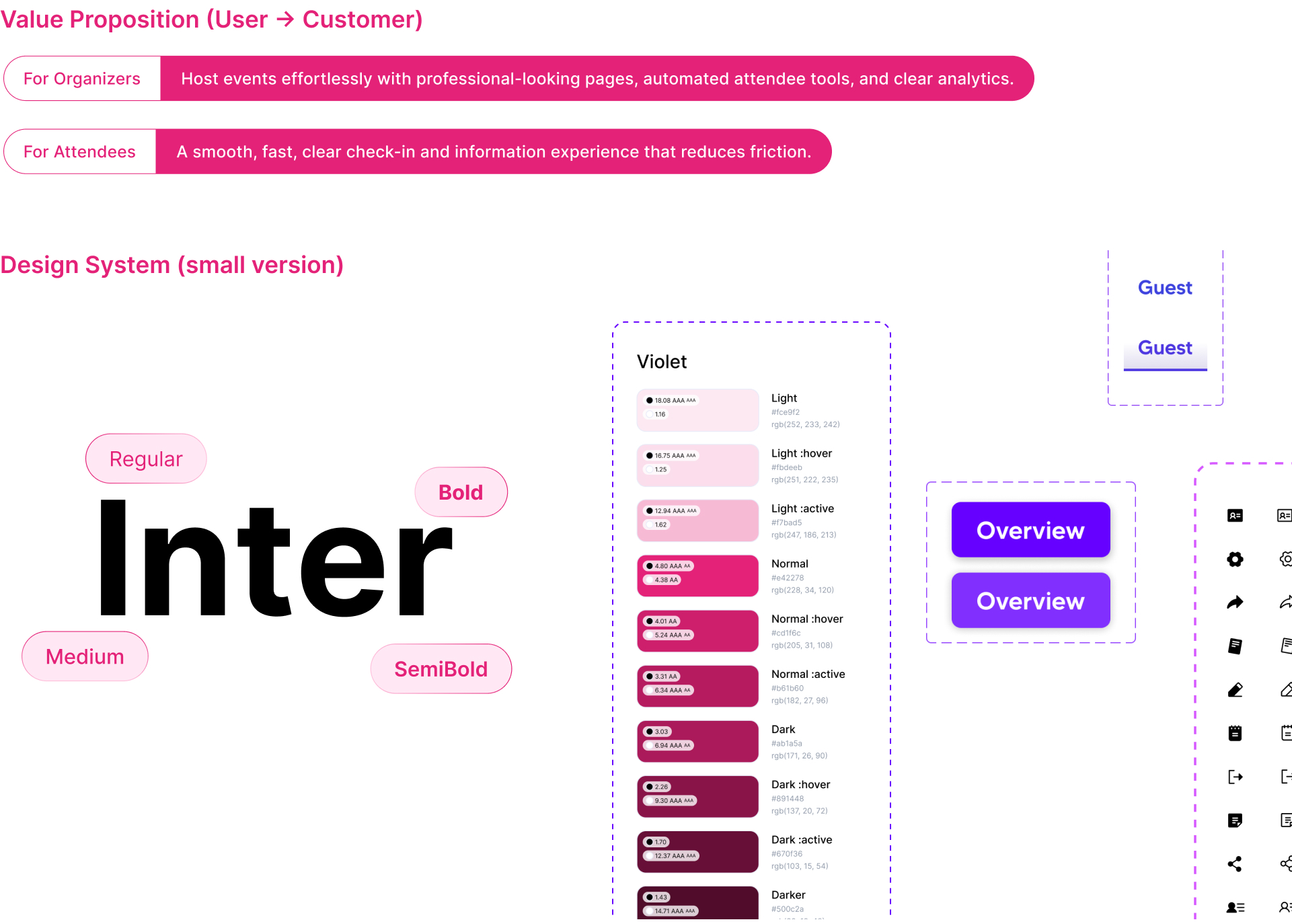
The creative direction for Guestify centers on building a modern and minimal visual identity that reflects both creativity and professional reliability. The overall experience is designed to prioritize clarity, ensuring that every interaction feels crisp, intuitive, and easy to navigate without overwhelming users with unnecessary elements. Warm color tones and spacious layouts were intentionally chosen to create an inviting atmosphere, giving users a sense of comfort and visual balance as they move through the platform. To elevate the experience further, subtle micro-interactions were incorporated, adding moments of delight while also reducing the user’s perceived effort and wait time. Together, these creative choices shape a product that feels polished, friendly, and effortlessly usable.
Design Thinking Process
EMPATHIZE
User Interviews
Spoke with organizers & attendees to uncover frustrations.
DEFINE
Problem Definition
Identified challenges in event setup, ticketing & visitor flow.
IDEATE
Concept Exploration
Created sketches, flows, and IA to explore possibilities.
PROTOTYPE
UI Prototyping
Built wireframes leading to interactive hi-fi prototypes.
TEST
Usability Testing
Tested with users → improved clarity, efficiency & trust.
IMPLEMENT
Final Execution
Delivered production-ready design with unified design system.
Competitive Analysis
To position Guestify meaningfully within the event-management landscape, I conducted an in-depth competitive analysis focusing on four major platforms: Luma, Eventbrite, Airmeet, and Townscript. My goal was to understand not only what these products offer, but also where users consistently experience friction, confusion, or unmet expectations. Through this research, I examined each competitor across dimensions such as onboarding flow, event creation complexity, branding flexibility, attendee management, pricing structure, and overall usability.
Luma stands out for its visually polished interface and creator-friendly aesthetic, but its limited customization options restrict event hosts who want deeper personalization. Eventbrite, although widely recognized and feature-rich, suffers from overwhelming navigation and complex multi-step flows that often discourage users—especially first-time organizers. Airmeet delivers robust virtual event capabilities, yet its heavy onboarding and steep learning curve make it intimidating for small organizers who just want to get started quickly. Meanwhile, Townscript performs well in the Indian market but lacks the modern UX patterns and streamlined experience today’s creators expect.
Across all platforms, a recurring pattern emerged: users desire a tool that is powerful yet unintimidating, flexible yet simple, visually modern yet operationally fast. This insight revealed a strong opportunity for Guestify to differentiate itself as an intuitive, lightweight, highly usable event platform that meets creators where they are — without overwhelming them with unnecessary complexity. By deeply analyzing these products through a UX lens, I shaped Guestify’s design direction around clarity, efficiency, and emotional satisfaction, ensuring the solution solves real problems rather than merely replicating existing patterns.
Insight-Driven Understanding: User Interview Summary
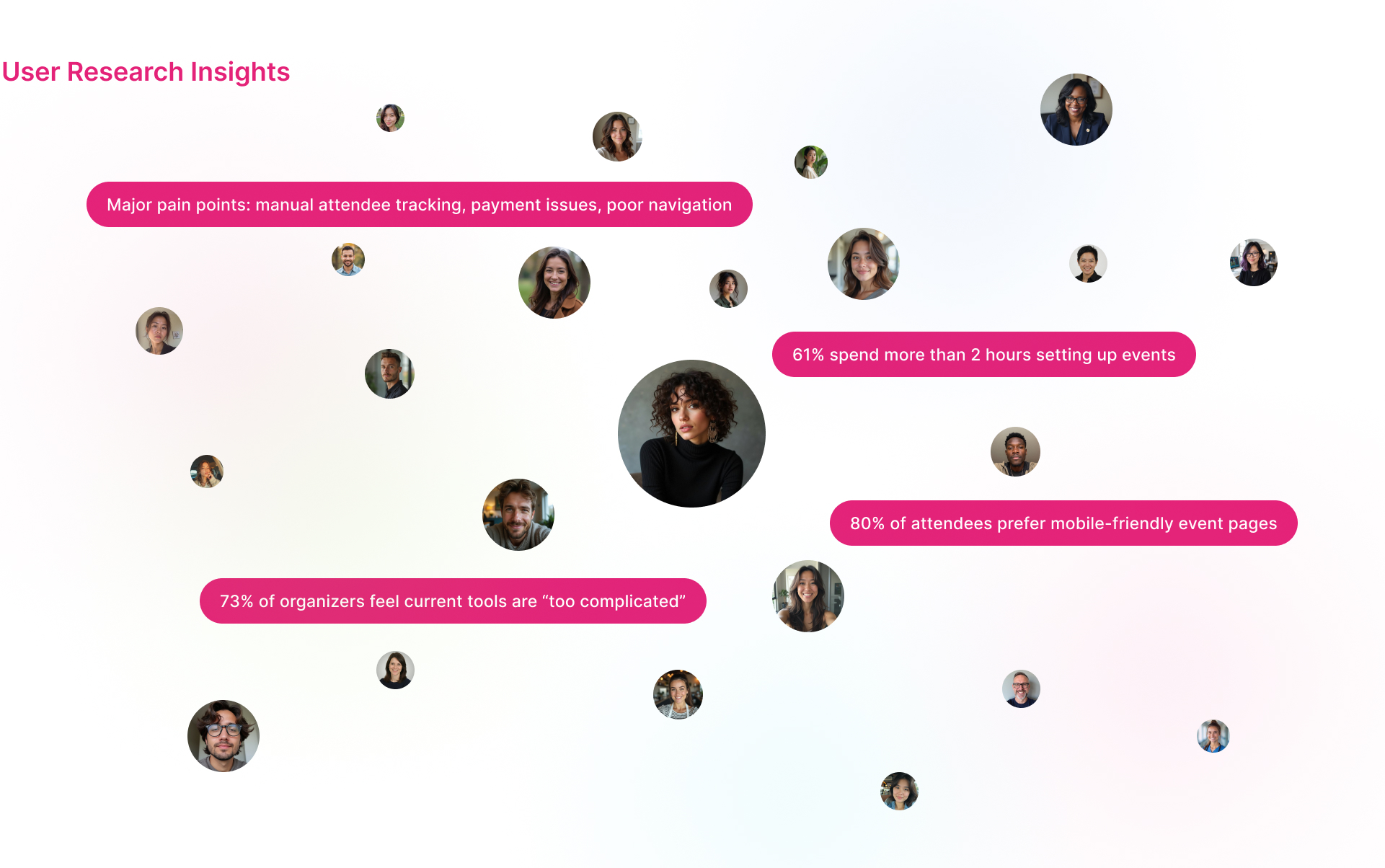
To ground the design of Guestify in real user needs, I conducted a series of structured interviews with event organizers and frequent attendees, focusing on uncovering behavioral patterns, workflow frustrations, and emotional triggers tied to event management. Over the course of multiple sessions,
I spoke with four organizers ranging from independent workshop hosts to corporate event managers, as well as six attendees who regularly participate in both online and offline events.
These conversations revealed consistent pain points: organizers repeatedly expressed frustration with the time-consuming process of setting up events across fragmented tools, emphasizing their desire for faster, more automated workflows that minimize repetitive tasks. Attendees highlighted the importance of clarity and ease of navigation, sharing how confusing event pages or multi-step check-ins often lead to frustration or even dropout. A recurring theme across both groups was the need for fewer steps and fewer decisions — users gravitate toward platforms that reduce cognitive load and make actions obvious. Interestingly, several organizers also noted that the visual presentation of their event page directly impacts trust and conversion, making design quality and branding flexibility critical. These insights became foundational in shaping Guestify’s product direction, validating my belief that deeply understanding human behavior early in the process is the key to creating intuitive, high-performing experiences.
Personas Rooted in Real Event-Industry Behaviors
Persona 1: The Creator – Aisha (Workshop Host)
Needs: A simple, visually polished event page, easy ticketing.
Frustrations: Too many forms, confusing dashboards.
Persona 2: The Event Manager – Rahul (Corporate Events)
Needs: Reliable attendee data, automated reminders.
Frustrations: Manual work across multiple apps.
Why Guestify Needs These Personas
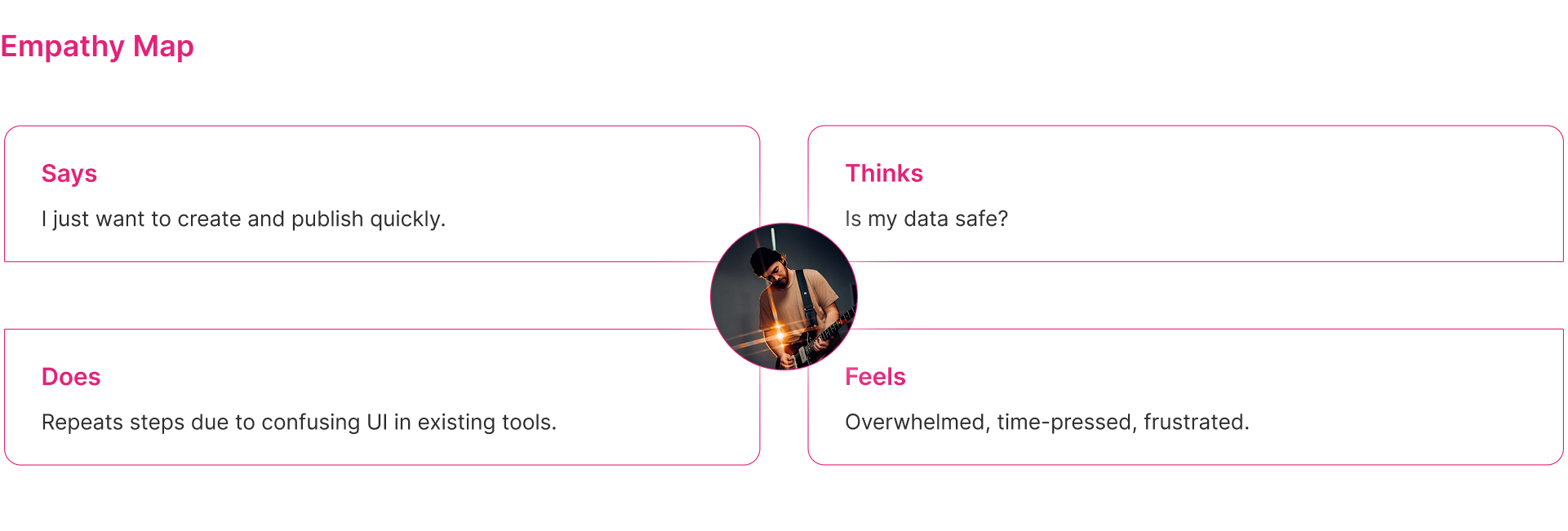
To build a platform that truly reduces the operational burden on event creators and managers, I needed to understand not only what they were trying to achieve but how they think, work, feel, and decide. These personas synthesize real behavioral insights gathered from interviews, shadowing sessions, and user journey breakdowns. They guided every design decision — from simplifying the event creation flow to structuring the attendee dashboard and shaping communication tools.
User Journey Map
Stages
Discover platform →
Create event →
Publish & share →
Manage attendees →
Post-event insights
Pain points mapped at each stage with opportunity areas
Through research, users consistently emphasized the need for a faster, template-driven event creation process that reduces repetitive work and allows them to launch events with confidence. They expressed frustration with existing ticketing flows that felt confusing or step-heavy, highlighting the importance of a simplified, intuitive purchase experience for attendees. Many organizers also stressed the value of real-time attendee insights to monitor registrations, engagement, and check-ins seamlessly—empowering them to manage events with clarity and control.
Design Impact & Key Learnings
While this case study does not showcase detailed wireframes or final UI mockups, the core focus of my work on Guestify was deeply rooted in understanding the problem space and shaping the product from an end-to-end experience perspective. I was heavily involved in defining the event creation flow, simplifying ticketing and attendee management journeys, and aligning user needs with business goals through research, interviews, and strategic thinking. This project taught me how critical early-stage UX decisions are in reducing long-term complexity, how research-driven insights can influence product direction, and how to balance user expectations with technical and business constraints. Guestify strengthened my ability to think beyond screens — focusing on systems, flows, and outcomes — which ultimately shaped me into a more thoughtful, research-driven product designer.